{:en}
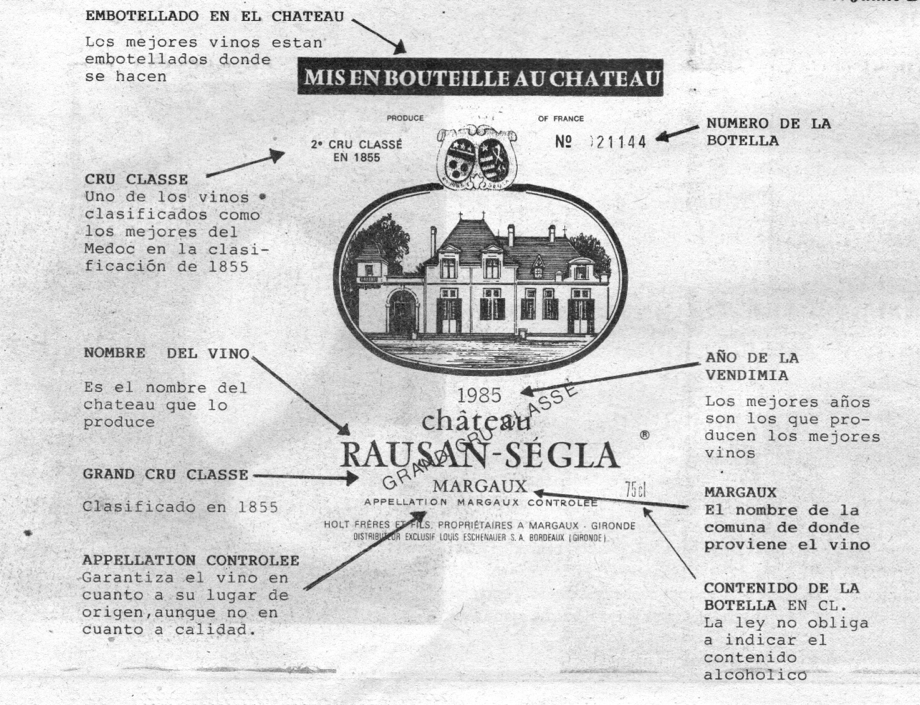
[wp_ad_camp_1]Here its before you a French wine label, specifically from the Medoc region, where red wine is almost exclusively made . What first catches the eye is the engraving of the chateau and in the second place, the name of the wine: Château Rausan-Segla. But these details aren’t the only ones to take into consideration. The first thing we look for in a good French wine is the Appellation d’Origine Contrôlée (AOC).
[spacer height=”20px”]
[spacer height=”20px”]
 [spacer height=”20px”]
[wp_ad_camp_1]{:}{:es}
[wp_ad_camp_1]
[spacer height=”20px”]
“El año de la vendimia es muy importante porque si el clima de ese año ha sido muy bueno, las uvas habrán madurado en forma óptima……”
[spacer height=”20px”]
No cabe duda de que el único modo de saber la calidad de un vino embotellado es comprar la botella, sacar el corcho y probar el vino. Pero podemos tener algunos elementos para saber de antemano lo que podemos esperar de una botella. La misma forma de la botella nos puede indicar el lugar de origen: botellas “con hombros”(Burdeos), “sin hombros” (Borgoña), tipo “flauta” (Alsacia), etc. Si el nivel de vino dentro de la botella es muy bajo podemos deducir que el vino tiene muchos años embotellado, o bien, que está mal encorchado. Pero el instrumento que mayor información nos puede dar acerca del contenido de una botella, es la etiqueta.
[spacer height=”20px”]
Es sorprendente saber que las etiquetas de vino se hicieron de uso general hasta alrededor de 1914; antes solamente se usaban en los mejores y más distinguidos vinos. Desde entonces las etiquetas se han vuelto más claras y concretas para asegurar un mejor reconocimiento del producto. Hay algunas etiquetas de fácil lectura, sobre todo por estar escritas en español. Otras pueden parecernos casi imposibles de entender, como las de vino alemán, a veces escritas con letras góticas.
[spacer height=”20px”]
Está ante ustedes una etiqueta francesa, específicamente de la región del Medoc, en donde casi exclusivamente se elabora vino tinto. Lo que primero nos llama la atención es el grabado del château y en segundo lugar, el nombre del vino: Château Rausan-Ségla. Pero estos datos no son los únicos a tomar en cuenta. Lo primero que debemos buscar en un buen vino francés es la Appellation d’Origine Contrôlée (AOC).
[spacer height=”20px”]
Los vinos franceses están catalogados en cuatro categorías, de menor a mayor calidad:[spacer height=”20px”]
1- Vin de Table (vino de mesa) en donde no se especifica la procedencia del vino; son vinos hechos en Francia, en cualquier lugar y con uvas de cualquier parte, hasta de países extranjeros.
[spacer height=”20px”]
2- Vin de Pays, un vino de mesa de mejor calidad, generalmente asociado a alguna región francesa, p. ej.: Aude, Loire, d’Oc.
[spacer height=”20px”]
3- V.D.Q.S. (Vin Delimité de Qualité Supérieure) que proviene de ciertas regiones, sobre todo del sur de Francia, que se consideran suficientemente buenos para ser controlados en su calidad y que garantizan su lugar de origen y las variedades de vid permitidas en la región, así como el grado alcohólico mínimo.
[spacer height=”20px”]
4- AOC (Appellation d’Origine Contrôlée) los mejores vinos franceses, en donde existen muchas reglas para el control de su calidad, métodos de cultivo, de vinificación, vides autorizadas, producción máxima, etc.
[spacer height=”20px”]
Si se trata de un vino de Burdeos deberemos buscar en la etiqueta la leyenda “Mis en bouteilles au château” que significa que el vino ha sido hecho y embotellado en la propiedad (ya no se vende vino en barricas) y esto es una garantía, porque todos los mejores vinos de Burdeos tienen que ser embotellados por el propietario del Château. En Borgoña es diferente. Como los viñedos pueden tener uno o varios propietarios, los grandes negociantes de vino compran la producción de varios viñedos, llevan a cabo la vinificación y la crianza del vino y embotellan el producto en sus cavas, por lo que en la etiqueta señalan “Mis en bouteilles au domain”. El Domain es la garantía de calidad, como lo es el Château en Burdeos. En Borgoña el embotellador es al que le interesa conservar el prestigio de su nombre asociado al vino. Es más importante conocer el nombre del negociante, que el nombre del vino.
[spacer height=”20px”]
Después buscaremos el nombre del vino, la fecha de la vendimia y otras especificaciones en cuanto al contenido de la botella en ml., contenido alcohólico en volumen o porcentaje, tipo de vino, etc.
[spacer height=”20px”]
El año de la vendimia es muy importante porque si el clima de ese año ha sido muy bueno, las uvas habrán madurado en forma óptima y el vino resultante tendrá las características de calidad que esperamos encontrar, cosa que no ocurrirá si el clima no ha sido bueno ese año.
[spacer height=”20px”]
Por último, en los vinos de Burdeos, el “Cru Clasée” indica que ese vino mereció su clasificación en 1855 como uno de los mejores vinos del Medoc. Entre alrededor de 3,000 châteaux, los 60 mejores se clasificaron con ese título. En Borgoña los mejores vinos se catalogan como “Premier Cru” y lo máximo es que sean
[spacer height=”20px”]
“Grand Cru”.
[spacer height=”20px”]
La etiqueta corresponde a un Segundo Cru Clasée de la comuna de Margaux.
[spacer height=”20px”]
[spacer height=”20px”]
Hay muchas otras etiquetas de vinos de otras regiones de Francia, pero los mejores vinos franceses son los de Burdeos y los de Borgoña.
[spacer height=”20px”]
[wp_ad_camp_1]
{:}